Houseplants
How do I fix an overwatered houseplant?
The short answer
Stop watering until the mix has dried to the plant’s appropriate level, make sure excess water can escape, and inspect roots if the plant remains wet or declines. Do not fertilize a stressed plant.
Overwatering is usually a combination of too much moisture and too little drainage, not simply one large watering. Roots need air as well as water.
Read the pattern before treating
| Pattern | What it can suggest |
|---|---|
| Watering on a fixed schedule | A calendar can keep soil wet when light or growth is low. The same interval may be too frequent in winter or for a large pot. |
| Poor drainage or dense mix | A pot without a hole, a blocked drainage path, or compact soil can trap water around roots even when the watering amount seems reasonable. |
| Low light and cool conditions | Plants use less water in dim or cool conditions, so the mix stays wet longer and roots are more vulnerable to decay. |
Compare the main branches
Watering on a fixed schedule
- A calendar can keep soil wet when light or growth is low. The same interval may be too frequent in winter or for a large pot.
More likely if
- The mix stays wet for many days and lower or inner leaves yellow or wilt
- The pot is heavy, drainage is poor, or water remains in a saucer/cachepot
Less likely if
- Another branch better matches the root-zone, light, pest, or surface-growth evidence.
Stop watering and empty any saucer or cachepot. Place the plant where it has suitable airflow and light, not in direct scorching sun as a quick fix.
Poor drainage or dense mix
- A pot without a hole, a blocked drainage path, or compact soil can trap water around roots even when the watering amount seems reasonable.
More likely if
- Roots are brown, soft, or declining and wilt persists despite wet soil
- The problem has progressed from excess moisture into root damage
Less likely if
- Another branch better matches the root-zone, light, pest, or surface-growth evidence.
Check whether the pot drains and whether the mix is compact. If the plant remains wet or smells sour, gently inspect roots and remove only clearly dead, soft tissue with clean tools.
Low light and cool conditions
- Plants use less water in dim or cool conditions, so the mix stays wet longer and roots are more vulnerable to decay.
More likely if
- The mix is wet but roots remain firm and the plant has only mild stress
- Correcting drainage and the watering interval may be enough without aggressive repotting
Less likely if
- Another branch better matches the root-zone, light, pest, or surface-growth evidence.
Repot only when the root or drainage problem requires it, using fresh suitable mix and a container with a drainage hole. Wait before fertilizing until new growth resumes.
Checks before you act
- Confirm that the root zone is actually wet below the surface before withholding or adding water.
- Empty standing water and confirm drainage holes are open.
- If decline is significant, inspect roots for firm healthy tissue versus soft, dark, decayed roots.
- Review pot size, potting mix, light, temperature, and season because all affect drying rate.
Route the strongest clue
- Root-zone or watering evidence is strongest: Continue with the more specific Houseplant guide.How often should I water houseplants?
- Light or environmental evidence is strongest: Continue with the more specific Houseplant guide.Why are my houseplant leaves drooping?
- Pest or surface-growth evidence is strongest: Continue with the more specific Houseplant guide.Why are my houseplant leaves turning yellow?
- A related Houseplant symptom is more specific: Continue with the more specific Houseplant guide.How do I get rid of fungus gnats in houseplants?
What to do now
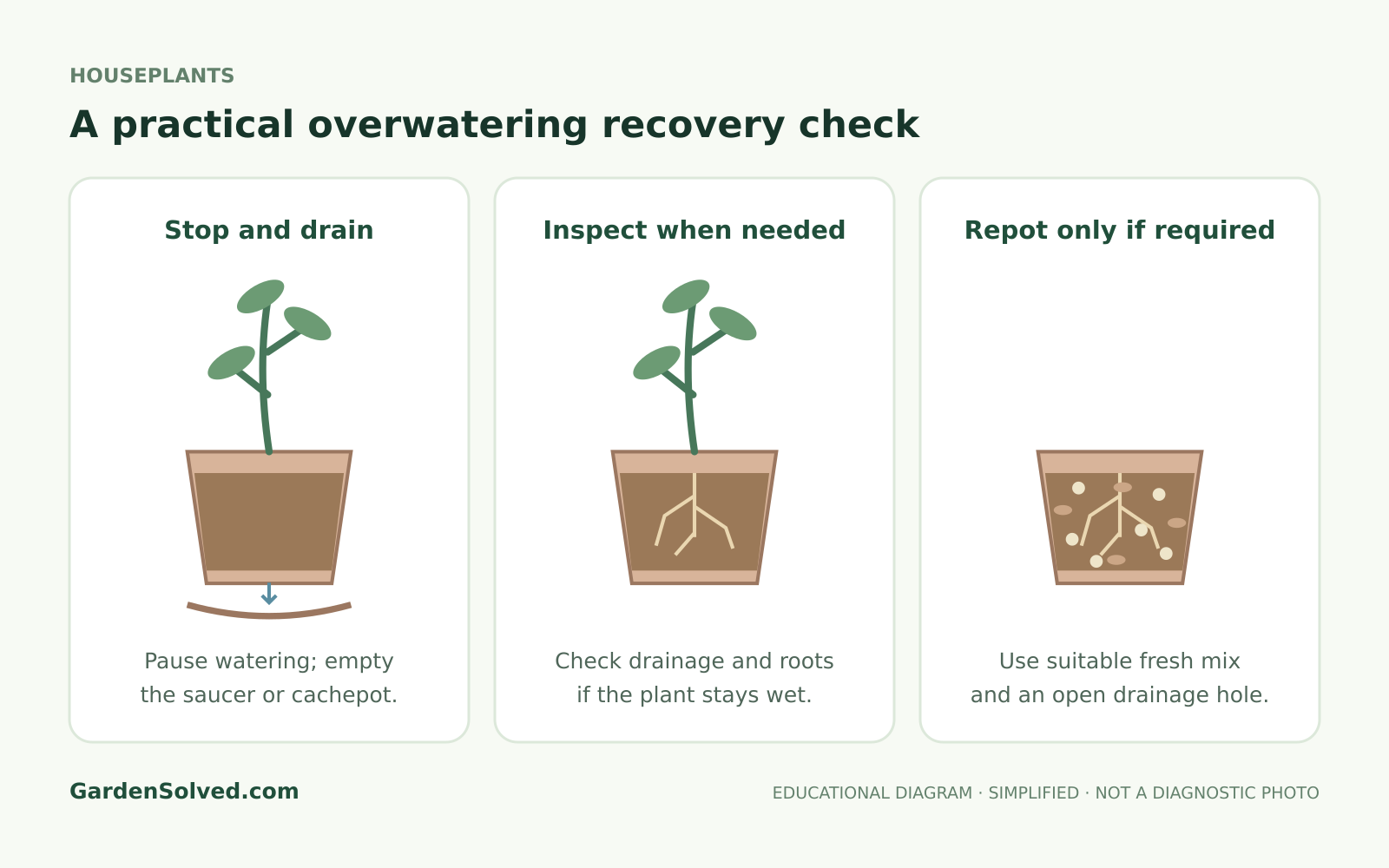
- Stop watering and empty any saucer or cachepot. Place the plant where it has suitable airflow and light, not in direct scorching sun as a quick fix.
- Check whether the pot drains and whether the mix is compact. If the plant remains wet or smells sour, gently inspect roots and remove only clearly dead, soft tissue with clean tools.
- Repot only when the root or drainage problem requires it, using fresh suitable mix and a container with a drainage hole. Wait before fertilizing until new growth resumes.
GardenSolved checkpoint
Do not do this yet
Avoid common shortcuts
- Do not water a wilted plant again until root-zone moisture is checked.
- Do not fertilize a plant with damaged or oxygen-starved roots.
- Do not repot automatically if the plant is only mildly overwatered and roots remain healthy.
- Do not let the pot stand in drained water.
Confirm the likely cause first, then choose the treatment.
What recovery looks like
- A mildly stressed plant should begin using water normally as the mix dries and roots regain oxygen.
- New leaves should remain firmer and repeated yellowing should slow.
- Root-rot recovery takes longer because new healthy roots must replace damaged tissue.
- If decline continues after moisture and drainage are corrected, use a root/crown disease diagnosis.
Reduce repeat problems
- Check soil moisture before watering and let the plant reach its appropriate dry-down level.
- Use a pot with drainage and never leave standing water around the roots.
- Adjust watering for light, temperature, season, and pot size rather than using one routine for the whole collection.
When to investigate further
If roots are mostly soft and dark, the stem is collapsing, or the plant continues to decline after drainage is corrected, the damage may be severe and a species-specific diagnosis is worthwhile.