Houseplants
How often should I water houseplants?
The short answer
Check the soil before watering. For many houseplants, feeling the mix about two inches below the surface is a useful starting point, but succulents, cacti, and moisture-loving plants need different intervals.
There is no single watering schedule for every houseplant. A small pot in bright light may dry quickly, while a large pot in a dim room can stay wet much longer.
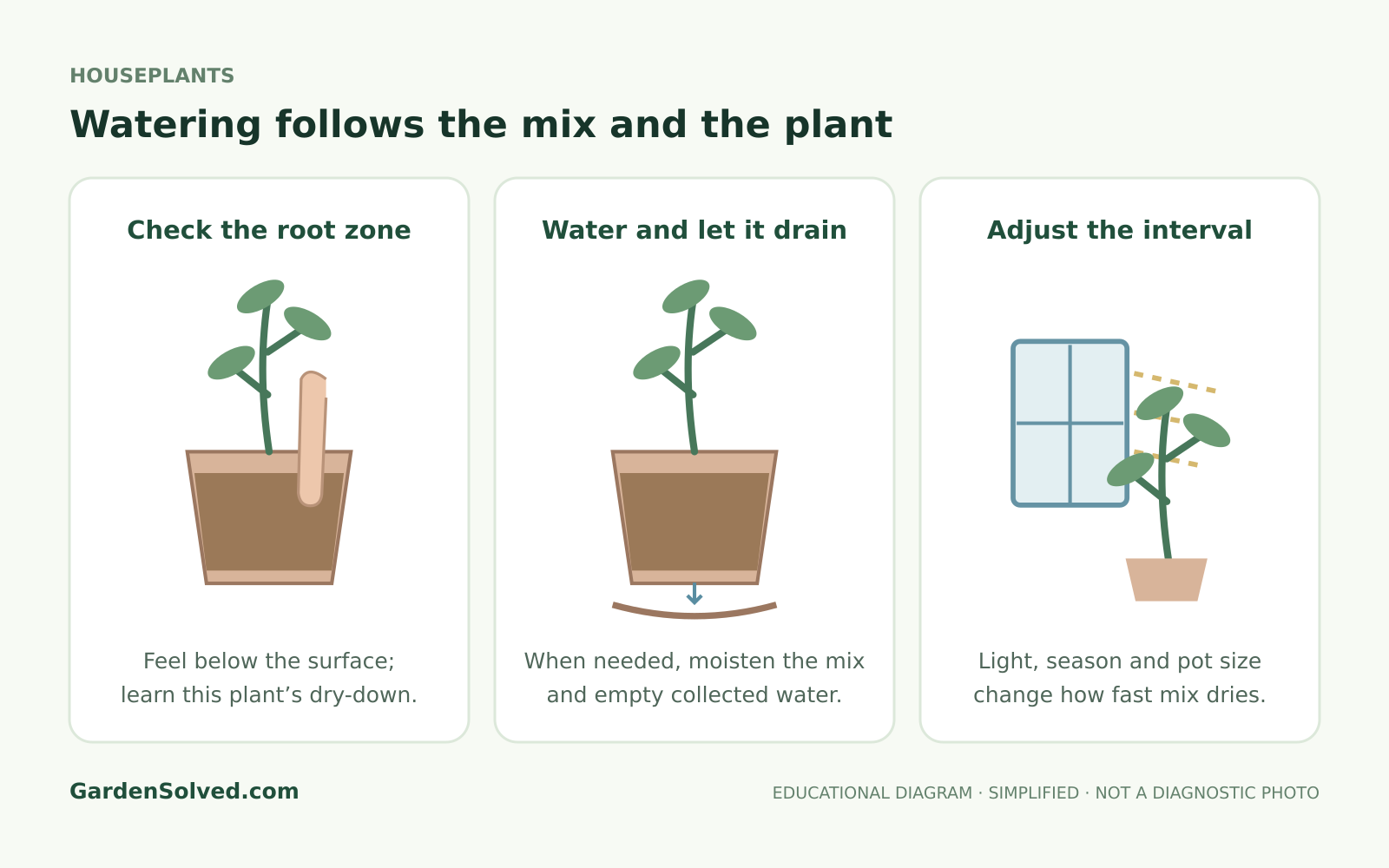
Read the pattern before treating
| Pattern | What it can suggest |
|---|---|
| Plant and pot size | Large pots hold moisture longer, while small pots and root-filled containers dry sooner. A plant’s species also determines how much drying it can tolerate. |
| Light, temperature, and season | Bright light, warm rooms, and active growth increase water use. Lower winter light or a cool room usually means the soil dries more slowly. |
| Poor drainage or compact soil | A pot without a drainage hole or a dense mix can remain wet even when the watering amount seems modest. Wet roots can decline while leaves still look thirsty. |
Compare the main branches
Plant and pot size
- Large pots hold moisture longer, while small pots and root-filled containers dry sooner. A plant’s species also determines how much drying it can tolerate.
More likely if
- The pot is small, root-filled, or the species uses water rapidly
- The mix dries appreciably between checks
Less likely if
- Another branch matches the root-zone condition and companion symptoms better.
Check the soil at root depth with a finger or moisture check rather than judging only the surface. Compare the weight of the pot before and after watering as you learn its pattern.
Light, temperature, and season
- Bright light, warm rooms, and active growth increase water use. Lower winter light or a cool room usually means the soil dries more slowly.
More likely if
- Light and room conditions have recently become warmer or brighter
- Water use has increased during active growth
Less likely if
- Another branch matches the root-zone condition and companion symptoms better.
When watering is needed, moisten the mix thoroughly until some water drains from the bottom, then empty the saucer. Water more gently for plants that require a drier cycle.
Poor drainage or compact soil
- A pot without a drainage hole or a dense mix can remain wet even when the watering amount seems modest. Wet roots can decline while leaves still look thirsty.
More likely if
- The mix stays wet for many days or water cannot drain freely
- Wilting occurs even though the potting mix is moist
Less likely if
- Another branch matches the root-zone condition and companion symptoms better.
Record how quickly the soil dries for a few weeks and adjust for light, temperature, plant growth, and the season instead of following a fixed calendar.
Checks before you act
- Check moisture below the surface at root depth instead of judging only the top layer.
- Lift the pot to learn the weight difference between a recently watered and a drying root ball.
- Confirm that drainage holes are open and empty standing water from saucers or cachepots.
- Adjust the interval when light, temperature, season, plant size, or potting mix changes.
Route the strongest clue
- Watering or root-zone stress is the strongest clue: Continue with the more specific Houseplant guide.How do I fix an overwatered houseplant?
- A companion leaf symptom is clearer: Continue with the more specific Houseplant guide.Why are my houseplant leaves drooping?
- Light or environmental conditions are the next question: Continue with the more specific Houseplant guide.Why are my houseplant leaves turning yellow?
What to do now
- Check the soil at root depth with a finger or moisture check rather than judging only the surface. Compare the weight of the pot before and after watering as you learn its pattern.
- When watering is needed, moisten the mix thoroughly until some water drains from the bottom, then empty the saucer. Water more gently for plants that require a drier cycle.
- Record how quickly the soil dries for a few weeks and adjust for light, temperature, plant growth, and the season instead of following a fixed calendar.
GardenSolved checkpoint
Do not do this yet
Avoid common shortcuts
- Do not use one weekly schedule for every houseplant.
- Do not water simply because the surface looks dry.
- Do not leave the pot standing in drainage water.
- Do not keep a species that prefers dry cycles continuously moist.
Confirm the likely cause first, then choose the treatment.
What recovery looks like
- A correctly watered plant should regain normal turgor if drought—not root damage—was the cause.
- The potting mix should drain freely and then dry at a rate appropriate to the species.
- New growth should remain firm without repeated yellowing or wilt between waterings.
- If wilt continues in wet soil, move to the overwatering/root-health pathway.
Reduce repeat problems
- Use containers with drainage holes and avoid leaving pots standing in water.
- Group plants with similar moisture needs and check newly purchased plants separately until you know their mix and roots.
- Reduce watering frequency when light levels fall or growth slows, while still following the needs of the specific species.
When to investigate further
If the soil is wet for many days, smells sour, or the plant wilts despite wet roots, stop adding water and check drainage and roots instead.