Houseplants
How much light does my houseplant need?
The short answer
Start with the plant’s light preference and observe how it responds. Bright light can mean direct or bright indirect light depending on the species; too little light often shows as slow growth, leaning, or pale leaves.
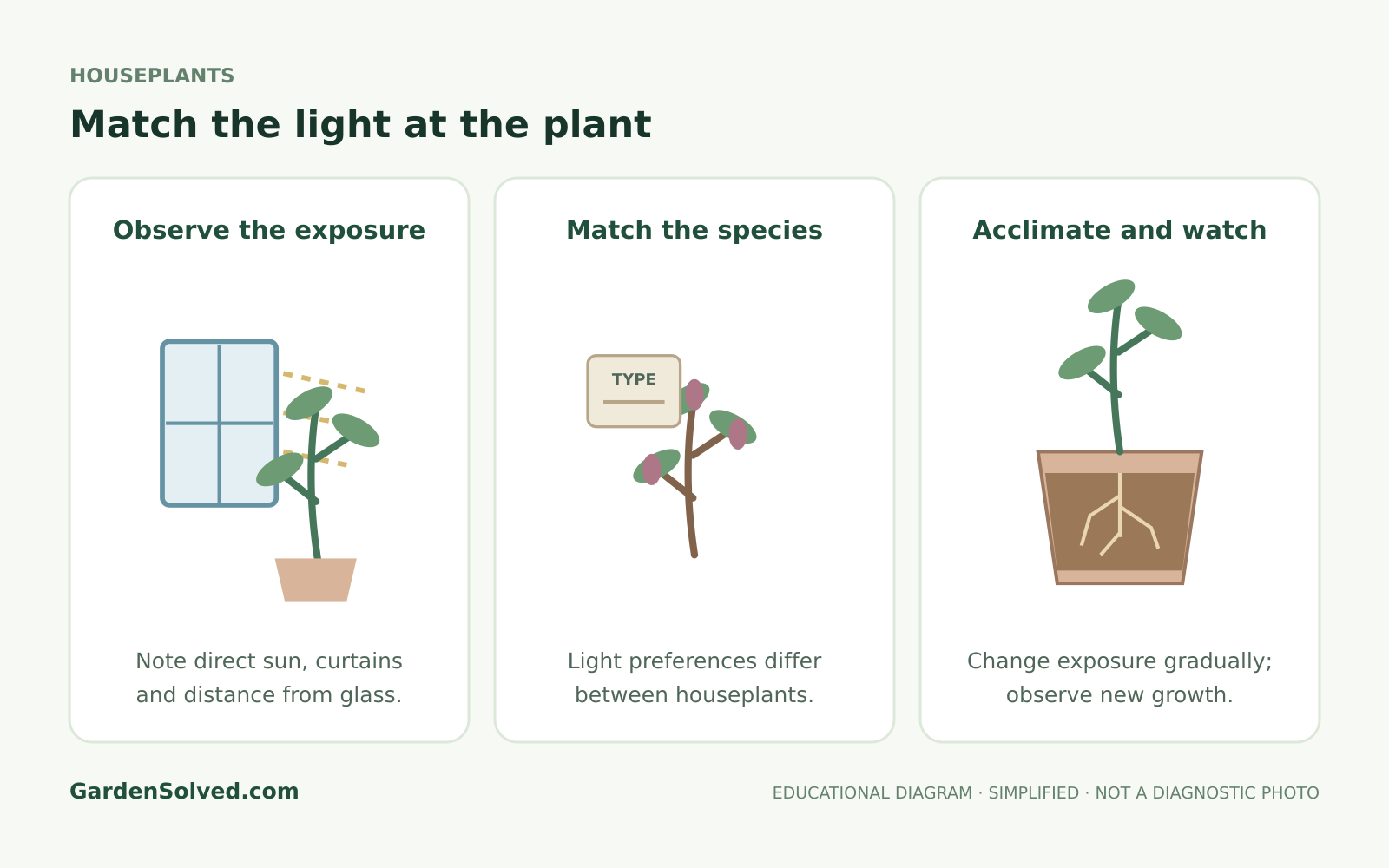
Light is more than a window label. The direction, season, glass, curtains, distance, and nearby buildings all change how much usable light reaches a plant.
Read the pattern before treating
| Pattern | What it can suggest |
|---|---|
| The plant is too far from the window | Light intensity drops quickly with distance. A bright room can still provide weak light where the plant actually sits. |
| Seasonal or outdoor shading changes | Winter sun is lower and weaker in many homes, while trees, buildings, blinds, and tinted glass can change exposure throughout the year. |
| Light is too intense for the species | Some plants scorch, bleach, or curl in strong direct midday sun, especially after being moved suddenly from a dim position. |
Compare the main branches
The plant is too far from the window
- Light intensity drops quickly with distance. A bright room can still provide weak light where the plant actually sits.
More likely if
- Growth is stretched, sparse, or leaning strongly toward the light
- Leaf drop or yellowing occurs on a plant placed far from useful window light
Less likely if
- Another branch better matches the root-zone, light, pest, or surface-growth evidence.
Identify the window direction, observe direct sun on the plant, and note whether curtains or nearby buildings reduce the light for part of the day.
Seasonal or outdoor shading changes
- Winter sun is lower and weaker in many homes, while trees, buildings, blinds, and tinted glass can change exposure throughout the year.
More likely if
- Leaves bleach or scorch after a move to much brighter light
- The damage is strongest on the most exposed foliage
Less likely if
- Another branch better matches the root-zone, light, pest, or surface-growth evidence.
Move the plant gradually toward brighter or softer light according to its species. Turn the pot periodically if it leans toward the window.
Light is too intense for the species
- Some plants scorch, bleach, or curl in strong direct midday sun, especially after being moved suddenly from a dim position.
More likely if
- The species is healthy but seasonal indoor light has fallen
- Growth slows without major root, pest, or disease symptoms
Less likely if
- Another branch better matches the root-zone, light, pest, or surface-growth evidence.
Watch new growth for several weeks. If using a grow light, follow its distance and duration instructions rather than placing it directly against foliage.
Checks before you act
- Identify the plant species and its light preference before moving it.
- Assess light where the foliage actually sits, including window direction, distance, obstructions, and seasonal change.
- Look for low-light clues such as stretched growth and leaf drop, versus high-light clues such as scorch or bleaching.
- Change light gradually and judge the response from new growth rather than already damaged leaves.
Route the strongest clue
- Root-zone or watering evidence is strongest: Continue with the more specific Houseplant guide.Why is my houseplant not growing?
- Light or environmental evidence is strongest: Continue with the more specific Houseplant guide.Why is my houseplant losing leaves?
- Pest or surface-growth evidence is strongest: Continue with the more specific Houseplant guide.Why are my houseplant leaves turning yellow?
- A related Houseplant symptom is more specific: Continue with the more specific Houseplant guide.How often should I water houseplants?
What to do now
- Identify the window direction, observe direct sun on the plant, and note whether curtains or nearby buildings reduce the light for part of the day.
- Move the plant gradually toward brighter or softer light according to its species. Turn the pot periodically if it leans toward the window.
- Watch new growth for several weeks. If using a grow light, follow its distance and duration instructions rather than placing it directly against foliage.
GardenSolved checkpoint
Do not do this yet
Avoid common shortcuts
- Do not use a single 'bright room' label as a measurement for every plant.
- Do not move a shade-adapted houseplant straight into harsh direct sun.
- Do not compensate for very low light by increasing fertilizer.
- Do not leave grow lights on continuously; plants also need an appropriate dark period.
Confirm the likely cause first, then choose the treatment.
What recovery looks like
- Adequate light should produce sturdier new growth with spacing and leaf size closer to the species norm.
- Old stretched stems or scorched leaves will not fully reverse.
- Seasonal slow growth can be normal if foliage remains healthy and the species is not actively growing.
- If growth stays poor in suitable light, check roots, watering, temperature, and pests next.
Reduce repeat problems
- Group plants by light preference instead of placing every plant in the same window.
- Clean dusty leaves gently when appropriate so the plant can use available light more effectively.
- Reassess light seasonally because a position that works in summer may be too dim in winter.
When to investigate further
If leaves scorch after a move, return the plant to gentler light and acclimate more slowly; do not compensate for low light with heavy fertilizer.