Houseplants
Why is my houseplant not growing?
The short answer
Start with light and roots. Too little light, poor drainage, a root-bound or damaged root system, unsuitable temperatures, inconsistent water, pests, and incorrect feeding can all limit new growth.
Slow growth is not always a problem: many houseplants naturally grow more slowly in low light or during a cool, dark season. Persistent decline or pale new growth deserves a closer check.
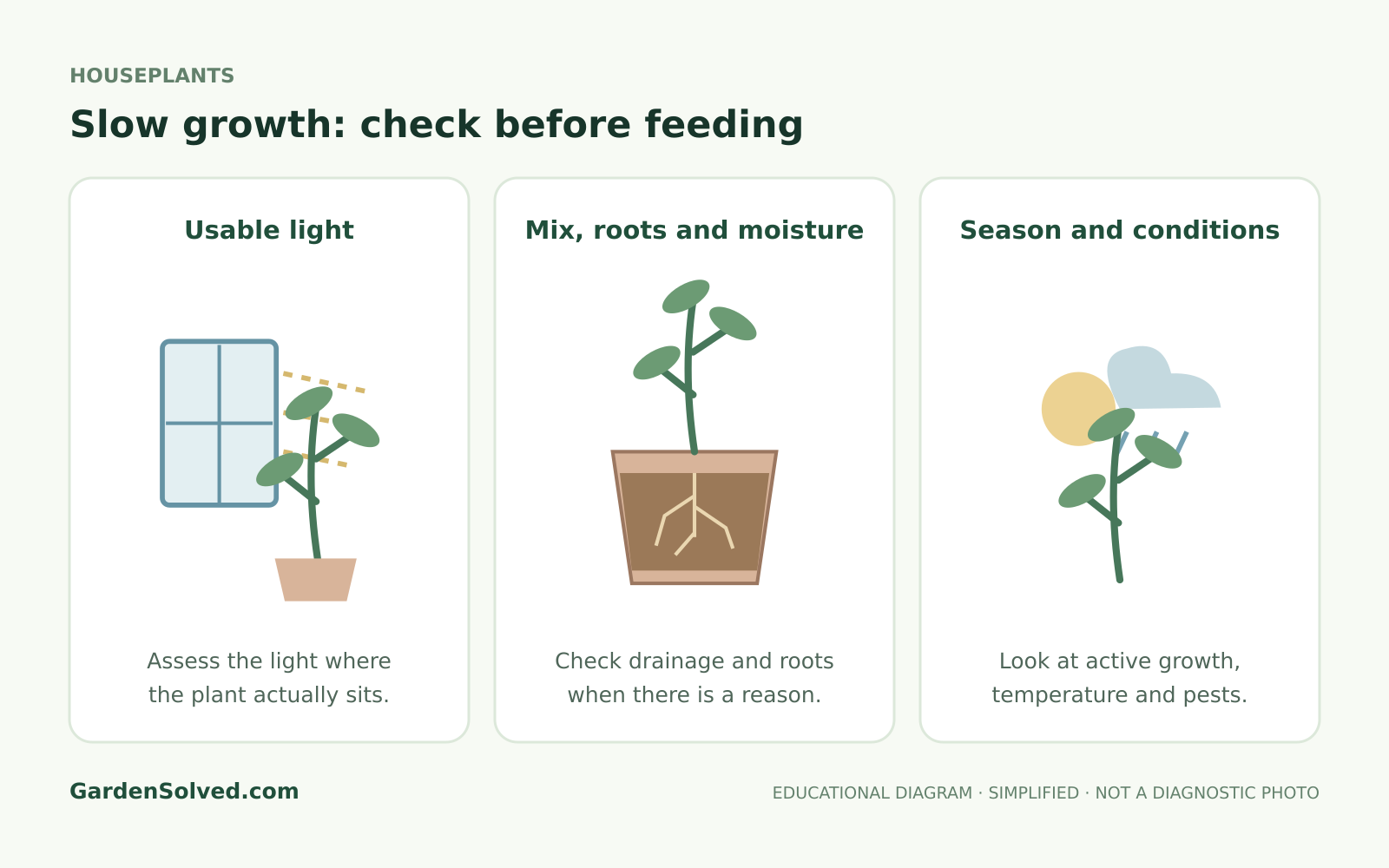
Read the pattern before treating
| Pattern | What it can suggest |
|---|---|
| Not enough usable light | A plant may survive in a dim spot but lack the energy to produce larger or more frequent new leaves. Distance from a window matters as much as the window direction. |
| Root or moisture problems | Waterlogged roots, severe dryness, compact mix, or a pot that is crowded with roots can interrupt uptake and slow growth. |
| Season, temperature, pests, or nutrition | Growth naturally slows in darker months. Cold drafts, pests, or a depleted or overfertilized mix can also create weak new growth. |
Compare the main branches
Not enough usable light
- A plant may survive in a dim spot but lack the energy to produce larger or more frequent new leaves. Distance from a window matters as much as the window direction.
More likely if
- Growth slows during short days or the plant is far from useful window light
- Stems stretch or leaves become smaller/paler rather than producing compact healthy growth
Less likely if
- Another branch better matches the moisture, environment, pest signs, or growth pattern.
Observe the light through the day and compare it with the plant’s needs. Move it gradually if the position is too dim or harsh.
Root or moisture problems
- Waterlogged roots, severe dryness, compact mix, or a pot that is crowded with roots can interrupt uptake and slow growth.
More likely if
- Roots are crowded, damaged, or held in persistently wet media
- Watering behavior changes and wilt or yellowing may accompany slow growth
Less likely if
- Another branch better matches the moisture, environment, pest signs, or growth pattern.
Check soil moisture, drainage, and roots only when needed. If the plant is root-bound or the mix has broken down, repot into a suitable container just one size larger.
Season, temperature, pests, or nutrition
- Growth naturally slows in darker months. Cold drafts, pests, or a depleted or overfertilized mix can also create weak new growth.
More likely if
- The plant is otherwise stable but is being fertilized heavily or not according to active growth
- Season and actual growth rate do not match the feeding routine
Less likely if
- Another branch better matches the moisture, environment, pest signs, or growth pattern.
Inspect new growth for pests and feed only during active growth with a suitable product at the label rate. Do not fertilize a dry or severely stressed plant.
Checks before you act
- Compare the plant's species-specific light need with the actual light at leaf level, including distance from the window.
- Check root-zone moisture, drainage, and whether roots are severely crowded or unhealthy.
- Review temperature, season, and whether the plant is in an active growth period.
- Inspect for pests and only then review fertilizer amount and label directions.
Route the strongest clue
- Watering or root-zone evidence is strongest: Continue with the more specific Houseplant guide.How much light does my houseplant need?
- A light or environmental clue is strongest: Continue with the more specific Houseplant guide.How often should I water houseplants?
- A companion leaf symptom is clearer: Continue with the more specific Houseplant guide.How do I fix an overwatered houseplant?
- A related Houseplant problem is more specific: Continue with the more specific Houseplant guide.Why are my houseplant leaves turning yellow?
What to do now
- Observe the light through the day and compare it with the plant’s needs. Move it gradually if the position is too dim or harsh.
- Check soil moisture, drainage, and roots only when needed. If the plant is root-bound or the mix has broken down, repot into a suitable container just one size larger.
- Inspect new growth for pests and feed only during active growth with a suitable product at the label rate. Do not fertilize a dry or severely stressed plant.
GardenSolved checkpoint
Do not do this yet
Avoid common shortcuts
- Do not assume slow growth always means the plant needs fertilizer.
- Do not move a shade-adapted plant directly into harsh sun to force growth.
- Do not repot solely because growth slows seasonally.
- Do not fertilize a plant with wet, damaged roots until the root problem is corrected.
Confirm the likely cause first, then choose the treatment.
What recovery looks like
- Improved light or stable root conditions should show in healthier new growth over time, not overnight.
- A naturally slower season may produce little growth while leaves remain healthy.
- If root crowding was limiting the plant, new root and shoot growth should resume after appropriate repotting.
- Persistent stunting with distorted or damaged new leaves needs a pest or disease check.
Reduce repeat problems
- Match each plant to an appropriate light level and rotate it occasionally for even growth.
- Refresh compact or exhausted potting mix when repotting is actually needed, not on an automatic schedule.
- Keep temperature and watering reasonably stable and reduce feeding when growth naturally slows.
When to investigate further
If new growth is severely distorted, pale, or covered in pests, or if roots are black and soft, identify the cause before adding more fertilizer.