Houseplants
Why is my houseplant growing leggy?
The short answer
Check the newest growth, not just old stretched stems. If internodes are lengthening, foliage is sparse, or the plant is reaching toward a window, improve usable light gradually. If light is already appropriate, review recent fertilizing and the plant's normal growth habit before pruning or feeding again.
Leggy houseplant growth means stems are becoming unusually long and thin, with wider spaces between leaves or growth leaning toward a light source. Low usable light is the most common first check, but excessive fertilizer can also contribute to soft, stretched growth.
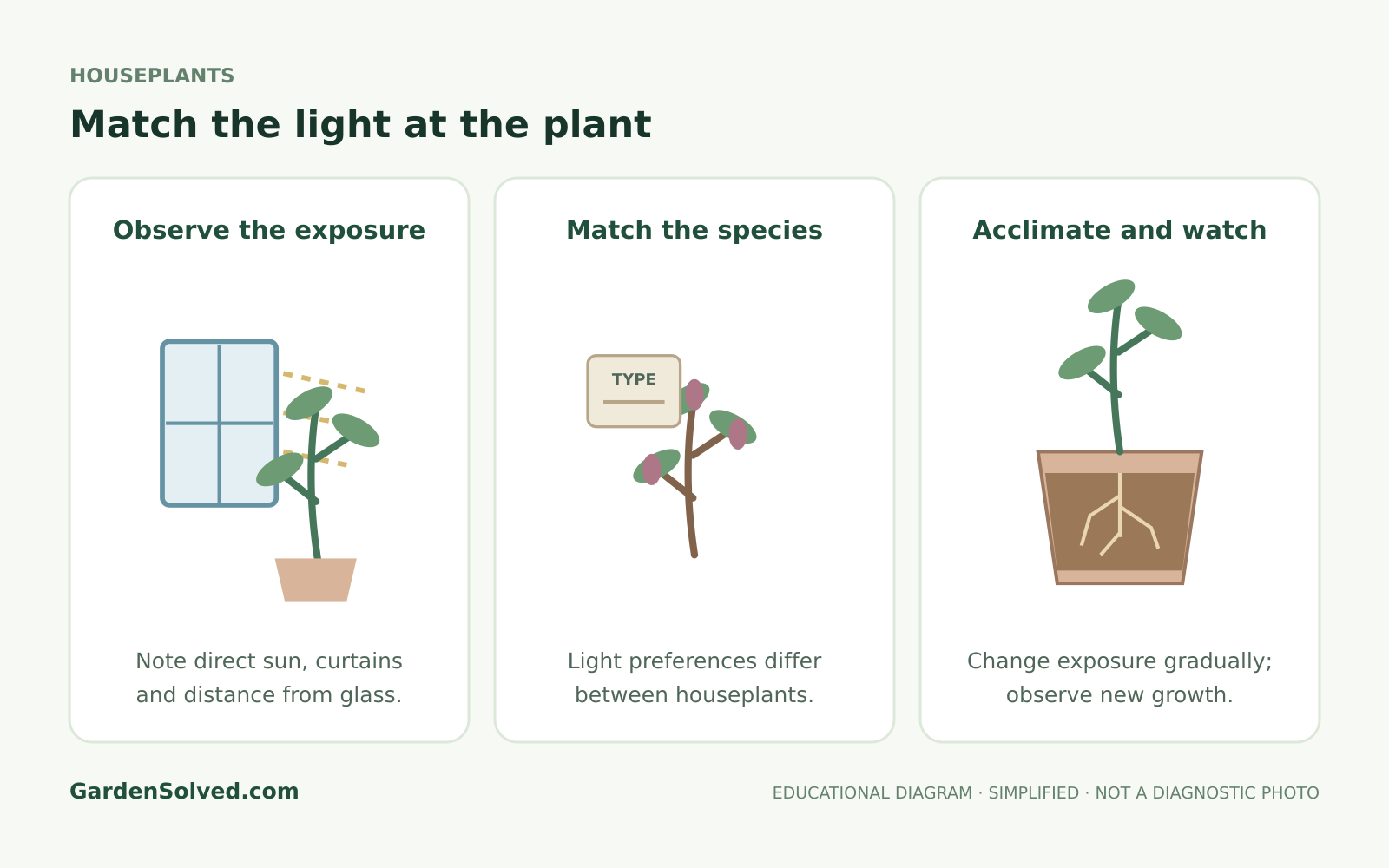
Read the growth pattern first
| Pattern | What it can suggest |
|---|---|
| Long internodes and growth reaching toward a window | Too little usable light is the first check. Plants in low light commonly stretch toward the available source. |
| Soft, very rapid growth after frequent feeding | Excess fertilizer can contribute to spindly growth, especially when light cannot support compact development. |
| Long stems but normal leaf spacing on a trailing or climbing species | The growth habit may be normal. Compare with the plant's usual form before treating height as a symptom. |
| Old stretched stems but newer compact growth | Conditions may already be corrected. Old internodes do not shrink, so judge recovery by new growth. |
Compare the main branches
Low usable light
- Long, thin internodes
- Growth angles toward a brighter window or lamp
More likely if
- New growth becomes more compact after light improves
Less likely if
- The plant receives appropriate light and has naturally long vining stems
Move the plant gradually to a brighter suitable position or add supplemental light appropriate for the species.
Excessive feeding
- Soft rapid growth
- Recent frequent or high-rate fertilizer use
More likely if
- Light is already appropriate and legginess accelerated after feeding
Less likely if
- The plant has not been fertilized and is clearly reaching toward light
Pause extra feeding and return to a species-appropriate fertilizer routine rather than trying to correct legginess with more nutrients.
Normal growth habit
- The species naturally trails, vines, or climbs
- Leaves remain normally sized and spaced
More likely if
- New growth is sturdy and healthy rather than pale or weak
Less likely if
- Internodes are becoming progressively longer and foliage is sparse
Use support, training, or selective pruning only if desired for shape.
Checks before you act
- Compare node spacing on the newest stem sections with older growth.
- Observe light direction for several days and note whether the plant consistently leans toward one source.
- Match the plant's light requirement to the actual location rather than assuming any indoor window is bright enough.
- Review fertilizer timing and rate before adding more nutrients.
Route the strongest companion clue
- The plant is also barely growing: Use the slow-growth diagnosis.Why is my houseplant not growing?
- You are unsure whether the location provides enough light: Use the Houseplant light guide.How much light does my houseplant need?
- Leaves are yellowing as growth stretches: Use the yellow-leaves diagnosis.Why are my houseplant leaves turning yellow?
What to do now
- Increase usable light gradually to a level appropriate for the species; avoid moving a shade-adapted plant abruptly into harsh direct sun.
- Rotate the pot periodically only after the plant has an appropriate light source; rotation cannot compensate for chronically low light.
- If fertilizer has been excessive, stop extra applications and resume only at a suitable rate during active growth.
- Prune stretched stems above a node if the species responds well to pruning and a fuller shape is desired, then judge the new growth.
GardenSolved checkpoint
Do not do this yet
- Do not add fertilizer just because the plant looks thin or sparse.
- Do not expect old stretched stems to become shorter after light improves.
- Do not repot solely because a plant is leggy unless roots or the potting mix show a separate reason.
- Do not move a plant abruptly from low light into intense direct sun.
Confirm the likely cause first, then choose the treatment.
What recovery looks like
- New internodes become shorter and sturdier.
- New leaves are held closer together and are better sized for the species.
- New growth leans less strongly toward one light source.
- Old leggy stems remain stretched; improvement is visible in the growth produced after conditions change.
Reduce repeat legginess
- Choose houseplants whose light needs match the available indoor location.
- Reassess light as seasons change and when plants are moved farther from windows.
- Use supplemental light when natural light cannot support compact growth.
- Fertilize to support healthy growth, not to compensate for insufficient light.
When to investigate further
If new growth remains weak, distorted, yellow, or collapsing after light and feeding are corrected, check roots, stems, pests, and the dominant companion symptom instead of continuing to increase light or fertilizer.