Houseplants
Why is there mold on my houseplant soil?
The short answer
Remove the visible growth, let the appropriate soil surface dry, improve airflow and drainage, and adjust watering. If the soil stays wet or fungus gnats appear, the moisture problem needs attention.
A white or fuzzy layer on the surface of potting mix is often fungal growth feeding on damp organic material. It is a signal to inspect moisture and drainage, not proof that the plant itself is diseased.
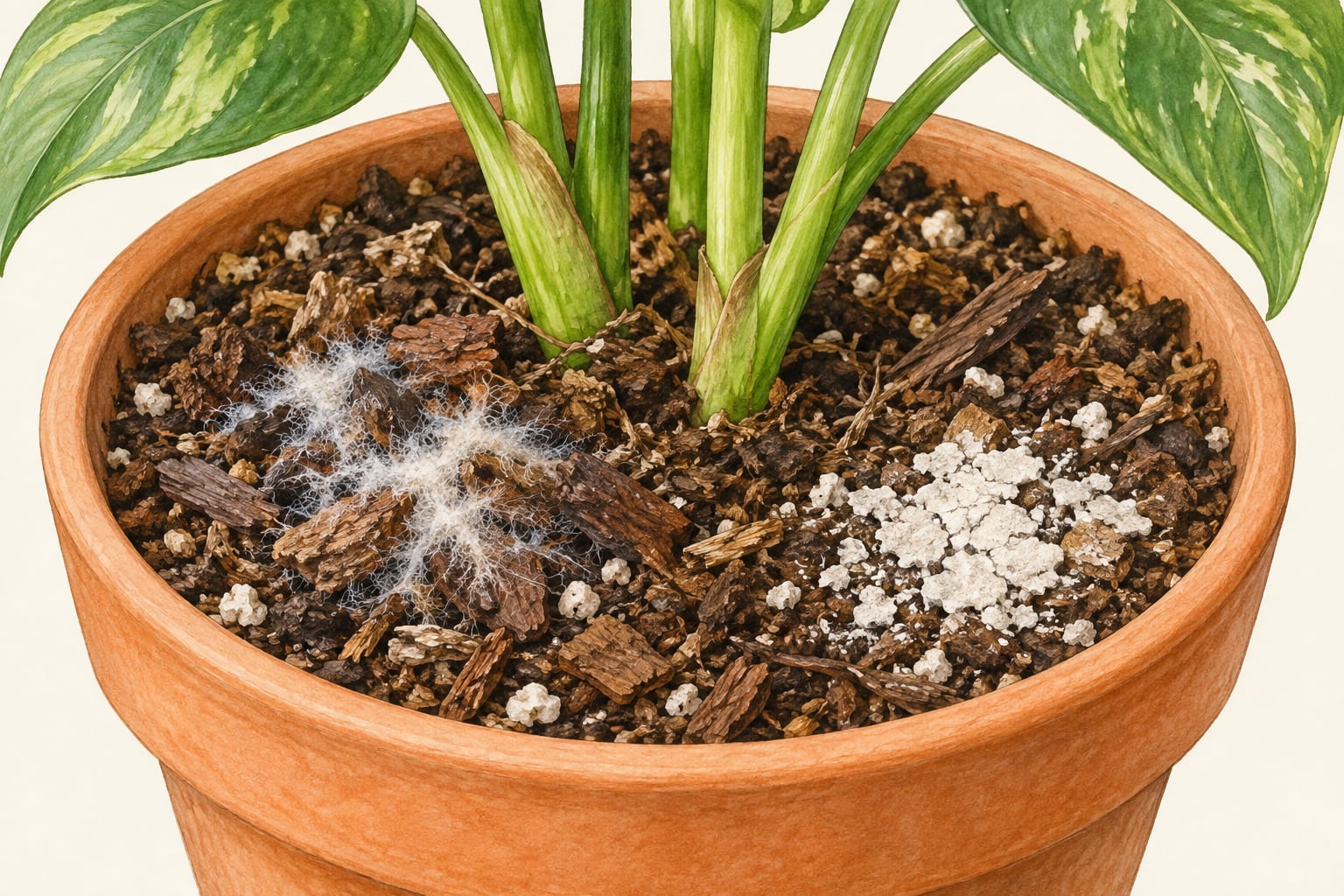
Read the pattern before treating
| Pattern | What it can suggest |
|---|---|
| Surface staying damp | Frequent watering, low light, cool temperatures, and poor airflow can keep the top layer wet long enough for surface fungi to grow. |
| Organic material in the mix | Fungi can feed on decomposing bark, leaves, and other organic matter without attacking healthy roots. The appearance alone does not identify a dangerous pathogen. |
| Poor drainage or a pot that is too large | A container that holds far more mix than the root system needs can remain wet for a long time, especially when the plant is growing slowly. |
Compare the main branches
Surface staying damp
- Frequent watering, low light, cool temperatures, and poor airflow can keep the top layer wet long enough for surface fungi to grow.
More likely if
- White to gray surface growth stays on the potting mix and the plant otherwise looks healthy
- The surface has remained moist and air movement is limited
Less likely if
- Another branch better matches the root-zone, light, pest, or surface-growth evidence.
Scoop away the affected surface layer and dispose of it. Do not spread it around other pots, and wash your hands and tools afterward.
Organic material in the mix
- Fungi can feed on decomposing bark, leaves, and other organic matter without attacking healthy roots. The appearance alone does not identify a dangerous pathogen.
More likely if
- A thick surface mat has formed or water no longer penetrates normally
- The growth is excessive enough to interfere with water infiltration
Less likely if
- Another branch better matches the root-zone, light, pest, or surface-growth evidence.
Check the drainage hole and moisture below the surface. Increase suitable airflow and light, but do not place a shade-loving plant in harsh direct sun.
Poor drainage or a pot that is too large
- A container that holds far more mix than the root system needs can remain wet for a long time, especially when the plant is growing slowly.
More likely if
- Small flies are also present or the plant is yellowing/wilting in persistently wet media
- The same moisture pattern may be supporting fungus gnats or root stress
Less likely if
- Another branch better matches the root-zone, light, pest, or surface-growth evidence.
Allow the mix to dry to the level appropriate for the plant before watering again. Repot only if drainage is poor, roots are damaged, or the mix has broken down.
Checks before you act
- Confirm that the growth is on the potting-media surface rather than on leaves or stems.
- Check how long the surface remains wet and whether the pot drains freely.
- Look for a thick crust/mat, fungus gnats, sour odor, wilt, yellowing, or soft roots that would make the moisture problem more significant.
- Improve air movement and watering practice, then watch whether fresh surface growth returns.
Route the strongest clue
- Root-zone or watering evidence is strongest: Continue with the more specific Houseplant guide.How often should I water houseplants?
- Light or environmental evidence is strongest: Continue with the more specific Houseplant guide.How do I get rid of fungus gnats in houseplants?
- Pest or surface-growth evidence is strongest: Continue with the more specific Houseplant guide.How do I fix an overwatered houseplant?
- A related Houseplant symptom is more specific: Continue with the more specific Houseplant guide.Why are my houseplant leaves turning yellow?
What to do now
- Scoop away the affected surface layer and dispose of it. Do not spread it around other pots, and wash your hands and tools afterward.
- Check the drainage hole and moisture below the surface. Increase suitable airflow and light, but do not place a shade-loving plant in harsh direct sun.
- Allow the mix to dry to the level appropriate for the plant before watering again. Repot only if drainage is poor, roots are damaged, or the mix has broken down.
GardenSolved checkpoint
Do not do this yet
Avoid common shortcuts
- Do not assume surface fungi automatically mean the houseplant has a systemic fungal disease.
- Do not keep the surface continuously wet to 'wash away' the growth.
- Do not apply a fungicide before correcting the moisture and airflow conditions that support surface growth.
- Do not ignore plant decline just because surface fungi themselves are often harmless.
Confirm the likely cause first, then choose the treatment.
What recovery looks like
- A thin surface growth should stop returning once the surface is allowed to dry appropriately between waterings.
- If a thick mat was removed, water should infiltrate the potting mix normally again.
- Fungus-gnat activity should also decline as the surface becomes less persistently damp.
- If the plant continues to wilt or yellow, move from the surface-growth issue to root-zone diagnosis.
Reduce repeat problems
- Water based on the plant and soil condition rather than a fixed schedule.
- Use a container with drainage and remove fallen leaves from the soil surface.
- Leave space between pots for airflow and monitor damp soil for fungus gnats.
When to investigate further
If mold is accompanied by a sour smell, soft roots, severe wilting, or rapid decline, investigate root damage rather than treating the surface growth alone.